Journal · Body care
Yoga for back pain basics
If you are pregnant, injured, or dealing with back pain, consult a doctor before you follow this page. Stop for sharp pain, numbness, dizziness, or chest pain. This is movement education, not a diagnosis or a treatment. Read the medical disclaimer.
If your back hurts, the first instruction is not a pose. See a clinician if the pain is new, severe, running down a leg, paired with numbness or weakness, or tied to an injury, a fever, or trouble with bladder or bowel control. Do not use a yoga page to wait that out. The National Center for Complementary and Integrative Health says this directly: do not use yoga to postpone seeing a health care provider about a medical problem.
What follows is for people who have already been told that gentle movement is reasonable, or who have an ordinary stiff back from sitting and want a careful way to move. It is not a program for a diagnosis we have not heard.
What the research summary actually says
NCCIH’s overview says research suggests yoga may have a small benefit for low-back pain. The details matter, because “yoga fixes backs” is not what the reviews found.
A 2022 Cochrane review looked at 21 studies with 2,223 participants on yoga for chronic non-specific low-back pain. NCCIH summarizes it this way: yoga was slightly better than no exercise, but the small difference may not be important to patients. There were slight improvements in physical function and in mental quality of life. It was unclear whether yoga differed from other kinds of exercise. The paper is Wieland and colleagues, Cochrane Database of Systematic Reviews, 2022, CD010671.
A 2017 clinical practice guideline from the American College of Physicians recommends nondrug approaches for the initial treatment of chronic low-back pain. Yoga is one of several suggested options, alongside things like exercise and heat, not a unique cure. The citation NCCIH lists is Qaseem and colleagues, Annals of Internal Medicine, 2017.
NCCIH also notes a 2020 Agency for Healthcare Research and Quality report that found yoga improved pain and function in the short and intermediate term, with effects similar to exercise and massage. Similar to other movement is a useful finding. It means a walk you will actually take, and a short yoga routine you will actually do, are in the same conversation. It does not mean a particular pose is medicine.
What we put in the back routines, and why
The 5-minute, 10-minute, and 20-minute back routines on this site stay small. They use Cat and Cow, Child’s Pose, Sphinx, a low Cobra, Bridge, and a Supine Twist. The longer routine adds a modest Locust and tells you to skip it if lying on the belly bothers you.
None of these are offered as a treatment protocol from a trial. Trials use different styles, different teachers, and different doses. NCCIH points out that those differences make yoga research hard to compare. Our routines are a gentle menu for a stiff back, taught in writing, with a timer so you do not hold a shape until you are bargaining with it.
Bend the knees in folds. Keep the neck quiet in Bridge. Come out of Sphinx the moment the lower back pinches. A smaller range is the modification, and it is still the pose. The pose pages say this in more detail. Read Sphinx and Cobra before you chase height.
Sitting all day is not the same as an injury
A back that feels dull after a laptop day often wants a change of position more than a deep backbend. The desk break is built for that: standing, a hinge with bent knees, a chair twist. Standing up and walking to the kitchen also counts as changing position. Yoga does not have to win against a walk.
If the stiffness is worse in the morning and eases as you move, gentle motion may feel good. If the pain is sharp when you arch, stop arching. Cat and Cow can be tiny. An inch of movement is a practice.
What not to do with a sore back
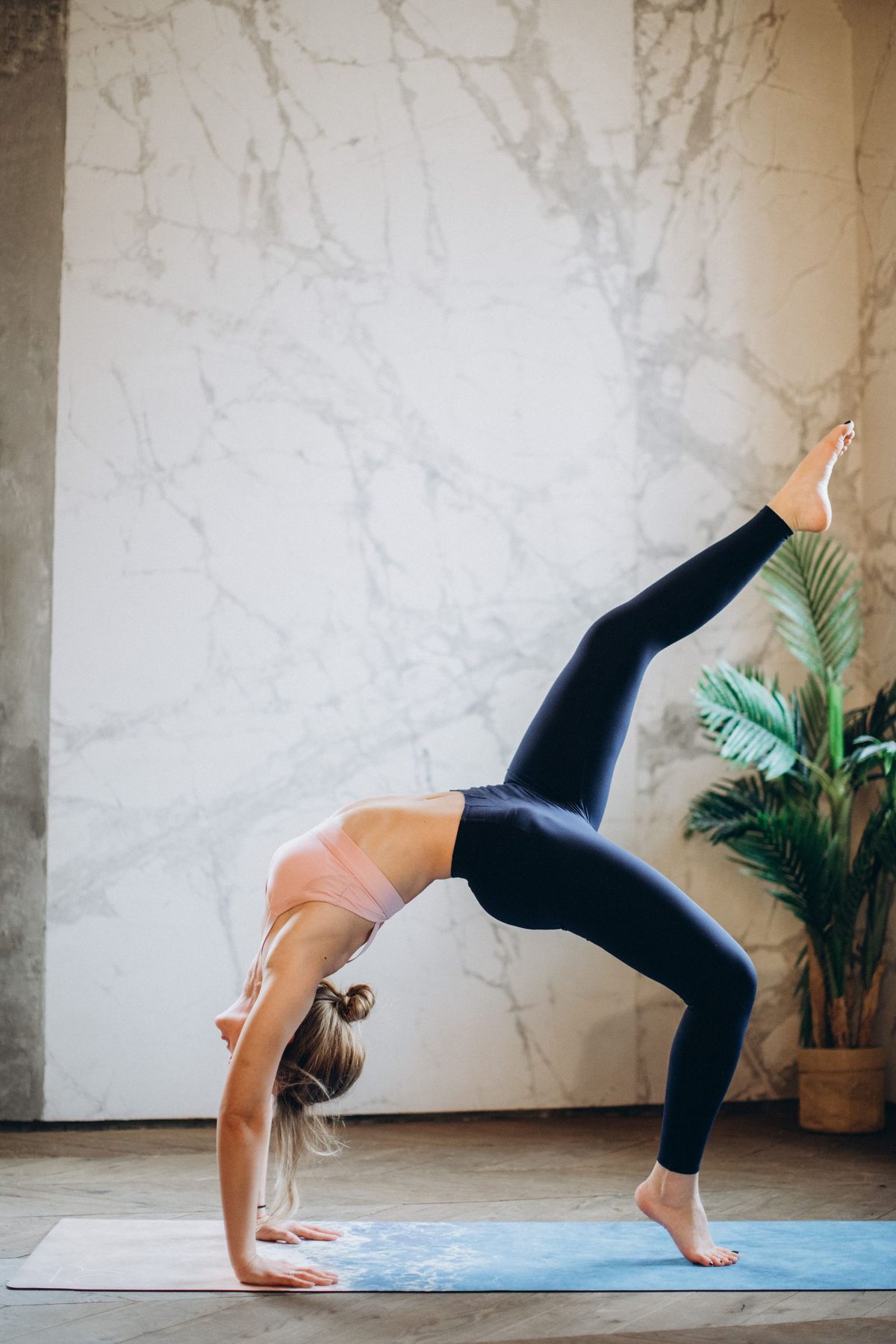
Do not force a fold with straight legs because a picture shows straight legs. Do not twist as far as you can turn your neck. Do not add a wheel pose, a deep camel, or a fast flow because you are impatient with feeling stiff. The beginner path’s Day 5 is the pace we mean.
Do not practice through numbness, weakness, or pain that is getting worse during the session. Soreness that shows up the next day and fades is a different experience from pain that changes how you stand. If you cannot tell which you have, that is a reason to ask a clinician, not a reason to add another round.
Hot yoga, long holds in extreme ranges, and practicing alone with an inversion are poor ideas when your back is the reason you came to the mat. NCCIH also notes higher rates of yoga-related emergency visits in adults 65 and older, and lists lumbar spine disease among the conditions that may call for modifications. Age is not a ban. It is a reason to choose the small version and to get advice that knows your history.
A reasonable week
If your clinician is fine with gentle movement, try the 10-minute back routine three times this week, and stop any pose that sharpens. On the other days, walk. Write one line in the tracker about what you skipped. That note is more useful than a perfect attendance record.
If nothing changes, or if you are worried, go back to the person who can examine you. A slight benefit in a review of chronic low-back pain is not a reason to be your own orthopedist. The medical disclaimer is the short version of this article. The long version is still: move kindly, and get care when the pain is a medical problem.
Sources: NCCIH, Yoga: What You Need To Know; Wieland LS, Skoetz N, Pilkington K, et al. Yoga for chronic non-specific low back pain. Cochrane Database of Systematic Reviews. 2022; CD010671; Qaseem A, Wilt TJ, McLean RM, et al. Noninvasive treatments for acute, subacute, and chronic low back pain. Annals of Internal Medicine. 2017;166(7):514-530.